

Does God Exist?
Hitchens, Craig, Burgis and Questioning the Question

In the article recently published on Substack (Hitch and the Philosopher: A Look Back at Christopher Hitchens's Debate with William Lane Craig) about Christopher Hitchens’s debate with William Lane Craig "Does God exist?" Ben Burgis argued that Hitchens did not present evidence that God does not exist. According to Burgis, the fundamental function of an atheist debater is to argue against the existence of God, and Hitchens missed the opportunity.
Hitchens avoided talking about the subject by claiming that "all observable phenomena (...) are explicable without a hypothesis (that God exists)." The fact that Hitchens did not find it necessary to explicitly deny the existence of God in the debate about the existence of God does not imply that he misunderstood the arguments put forward by Lane Craig as suggested by Ben Burgis. Rather, it is a gesture showing the pointlessness of an ill-conceived discussion in which it is impossible to frame the topic. Sometimes statements outside the framework of rational discourse cannot be adequately addressed as subjects of rational discourse. Arguments such as that the existence of objective moral values is the proof of God’s existence are embarrassingly irrational and addressing them rationally would assign them needless significance. Ignoring such statements may not be a failure to address them but silent arguments expressed within the same mythopoetic language - by showing.
Discussion question: "Does God exist?" assumes the name God as a valid premise that allows the existence of God to be affirmed or disputed. That means we agree that the signifier God has a common reference as a valid premise before we begin the discussion. But, there is no such common reference. The basic prerequisites for a rational discussion are provisional agreement on the meaning of the subject of discussion and a mutual willingness to reexamine own positions. Consensus on the subject matter and assumptions of goodwill are necessary foundations of the rational debate. But, the term God has very different meanings for theists and atheists. Understanding the word is predetermined by fundamental differences in the worldview, differences defining identities and assumptions that condition the possibility of discussion.
Let's imagine the question: Does Humpah-thumpah exist? The question of whether there is a Humpah-thumpah could only be valid if we can recognise something as a Humpah-thumpah. For someone who does not have the slightest idea what Humpah-thumpah might mean, it is impossible to discuss its existence or non-existence. To make something the subject of a rational discussion, we need a reference. Furthermore, without agreement on the meaning of the premise, there is no possibility of meaningful conversation. If the term Humpah-thumpah lacks a mutually recognised signified, it is either a poetic sign - a floating signifier, or a false concept that can neither be proven nor disproved. In other words, the Humpah-thumpah refutation only makes sense if there is something we name Humpah-thumpah and we agree on what the name Humpah-thumpah represents. As long as the interlocutors cannot agree on the meaning of the premise, but agree with the assessment that the opposite party does not understand what Humpah-thumpah means, there can be no coherent conversation about Humpah-thumpah. The recognised absence of a Humpah-thumpah reference makes the discussion about its presence or absence superfluous.
Wittgenstein referred to the absence of reference as a non-sense based on a misunderstanding of language. The language of philosophy is full of such linguistic orphans – words without meanings, words that may bare some poetic emotional significance but are without reference required for valid propositional communication. In short, the personal experience of faith is in the mythopoetic realm, outside the framework of logical-discursive language. In the Christian sense, religious experience is a matter of showing and following, not justifying. "My deeds are my credentials" (Christ in John 10, 25-27). In Tolstoy's interpretation, "Belief must be given not to words but to deeds" (1943, The Gospel in Brief, p. 194). That is, behaviour precedes logical-discursive interpretations of behaviour and reveals the truth that is "light itself" and, "just as you cannot illuminate light, so you cannot prove the truth of truth." (Ibid, p. 191) In Tolstoy’s argument, Wittgenstein traced the limits of logical-discursive language concerning the realm of human values, fate and emotions and concluded that “what we cannot speak about we must pass over in silence” (Wittgenstein, Tractatus Logico-Philosophicus, 1922, 7).
We behave in a certain way based on individual patterns of behaviour, a kind of knowledge that sometimes has no rational justification and does not require definitions. Attempts to expose this knowledge with rational arguments can be as futile as attempts to justify it with rational arguments. Words do not reside in experiences and are their own kingdom. In Aristotle's terms, the realms of actual experience and logos are very different from the realms of possible experiences or mythos. Correspondingly, in our time we distinguish propositional and aesthetic functions of language. The former sets the aim of language to be transparent to the reference, and the latter, to challenge the limits of language by attempting to represent unrepresentable. This means that religious truths should not be confused with reality and propositional truths of logical discursive reasoning. Religious truths are related to the experience of the unrepresentable and are the domain of the mystical. It is an area where the instruments of logic and rational thinking have personal nightmares.
The principle behind the rational discussion of God's existence requires a provisional understanding of God's existence as hypothetical. However, religious people put their fate before rational knowledge and deny the possibility of changing their beliefs based on any logical justifications for their behaviour, no matter how reasonable they may be. God is before reason. Therefore, reason cannot dispute the existence of God. Rejecting God as the prime mover of everything, including hypothetical positions that would allow debates about God's existence, is therefore out of the question. All existence is subject to God's existence, and there is no point in discussing God's existence if God is prima causa of all existence. If God is a premise understood as a condition of any discussion, it makes no sense to make his existence the subject of any discussion. That is why for believers, debates about the existence of God cannot but end up as dogmatic claims. Religious apologetics that employs rational thinking always ends up as a justification of personal, direct experience of God with irrational truth of faith, not reason. So, God is a proof of morality and morality ends as the proof of God’s existence. Commonly unaware of the vicious regress implied by their arguments, believers insist on the supposedly obvious necessity of the existence of a prime mover (cosmological argument) and the existence of an apparent perfect order that obviously requires supreme intelligence (teleological argument).
Indeed, we may question the intellectual honesty of individuals who agree to engage in a rational debate in which they regard the subject a priori as non-negotiable, and accept the implied antinomy as a welcome expression of God Moves in a Mysterious Ways.
On the other hand, for a rational thinker to take collective delusions or a subjective sense of the presence of a supreme being as proof of God's existence is simply too far-fetched to be taken as a valid rational argument. For atheists, who rely on rational thinking and have no physical experience of God's presence, God is a cultural construct, a false concept with no reference to anything existing. Presented as the focal point of the universe, beyond experience but offered for granted, it is a paradigm of dogmatism that fits well with Plato's belief in noble lies. God is useful to society just as Santa Claus is useful to children - an invention of a cunning doctrine exposed by Criteas (Sisyphus Fragment, Sextus Empiricus Against the Physicists, Book 1, Section 54).
Arguing about the existence of reference outside of experience makes no sense, just like the hypothetical suspension of disbelief in God's presence if belief is not there in the first place. God is not a necessary premise for the existence of the world; therefore, there is no need to confirm or dispute its presence.
Put simply, when speaking of God, the theist signifies the presence of a supreme being, and the atheist, the presence of a false concept that points to a nonexistent referent—a sign of an absent supreme being. The question of God's existence is not the same for theists and atheists to allow their rational discussion. When they talk about God, theists and atheists neither discuss the same subject nor follow the same rules of the debate; it is no wonder such attempts are intellectually futile.
If all attempts at illuminating light by light are doomed to failure, then it is very doubtful whether rational arguments can ever be successfully applied in the justification of religion. According to Wittgenstein, rational and religious arguments are simply in different registers of language.
The problem, well framed by Levinas's critique of the Christian theodicy, is in the attempts to interpret metaphorical truths of religious experience and fate literally (Levinas, 1998, "The Useless Suffering, Entre Nous: Thinking-Of-The-Other"). A religious experience may be profound, deeply emotional, meaningful and justified. As soon as it shifts from particular individual experiences into universal platitudes and measures of morality, it ends up employed by institutional logical discursive reasoning in controlling the behaviour of others. As a justification for human suffering, religion is transgressing the scope of personal experience with prospects of becoming the origin of evil - "the source of all immorality and a generator of suffering" (Levinas 1998, p.99) - the "cunning doctrine" exposed by Criteas.
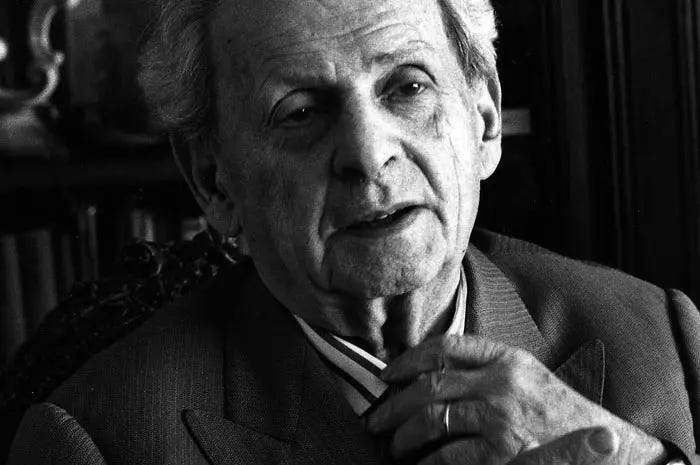
Emanuel Levinas, Image courtesy by Dialektika (2023)
Atheist views, which point to the abuse of religion, are well supported by numerous historical examples where religion has been used to justify evil. On the other hand, it is also a fact that every abuse of religion has been accomplished with the help of words in political justifications that claim "rational status" - like light trying to illuminate the light. It follows that most atheists' arguments deal with the false morality and light-bearing institutions of false theists. The evils of religion, just like the abuses of human values, are, as a result of more or less deliberate political strategies, employed by confusing the referential (propositional) and mythopoetic functions of language. The principle is: “Confuse logic with feelings, reason with fate, normalise cognitive dissonance and rule the world.”
Just as it makes no sense to question the existence of Humpah-thumpah if there is nothing we could recognise as Humpah-thumpah, it makes no sense to question the Humpah-thumpah if its existence is the core mystical belief of the opponent.
Hitchens pointed to the absence of a mutually accepted "God" premise that would allow the question "Does God exist?" In rational thinking, God is an empty signifier before any eventual discussions about his existence. Hitchens follows Wittgenstein in stating that we should keep the realms of logic and mysticism separate. The argument about the impossibility of identifying a plausible reference for the claims of God’s existence or non-existence should have been enough to close the debate. Hitchens's refusal to argue the non-existence of God is showing and repeating Wittgenstein’s statement: “what we cannot speak about we must pass over in silence.”
Literature
Levinas, E, 1998, Useless Suffering, in Levinas, E, Entre Nous: Thinking-of-the-Other, Columbia University Press, New York.
Tolstoy, L, N, 1943, The Gospel in Brief, Cornell University Library.
Wittgenstein, L, 1922, Tractatus Logico-Philosophicus, Trans C.K Ogden, Kegan Paul, Trench, Trubner & CO.LTD, London, Harcourt, Brace & Company, INC, New York.